What’s new this week
How do you measure a race nobody has entered yet?
No Republican has formally declared for 2028. Three instruments still give a useful reading:
- Prediction markets such as Kalshi and Polymarket, where traders buy contracts that pay out if a candidate wins. A price of 34 cents means the market puts that candidate’s chances at about 34%.
- Polls of likely primary voters, which measure today’s preference. This far out, they mostly reflect name recognition.
- Signals from the party itself: whom Donald Trump blesses, where the big donors go, who actually decides to run.
Each measures something different. Read together, they show a contest that has shifted.
What the markets say
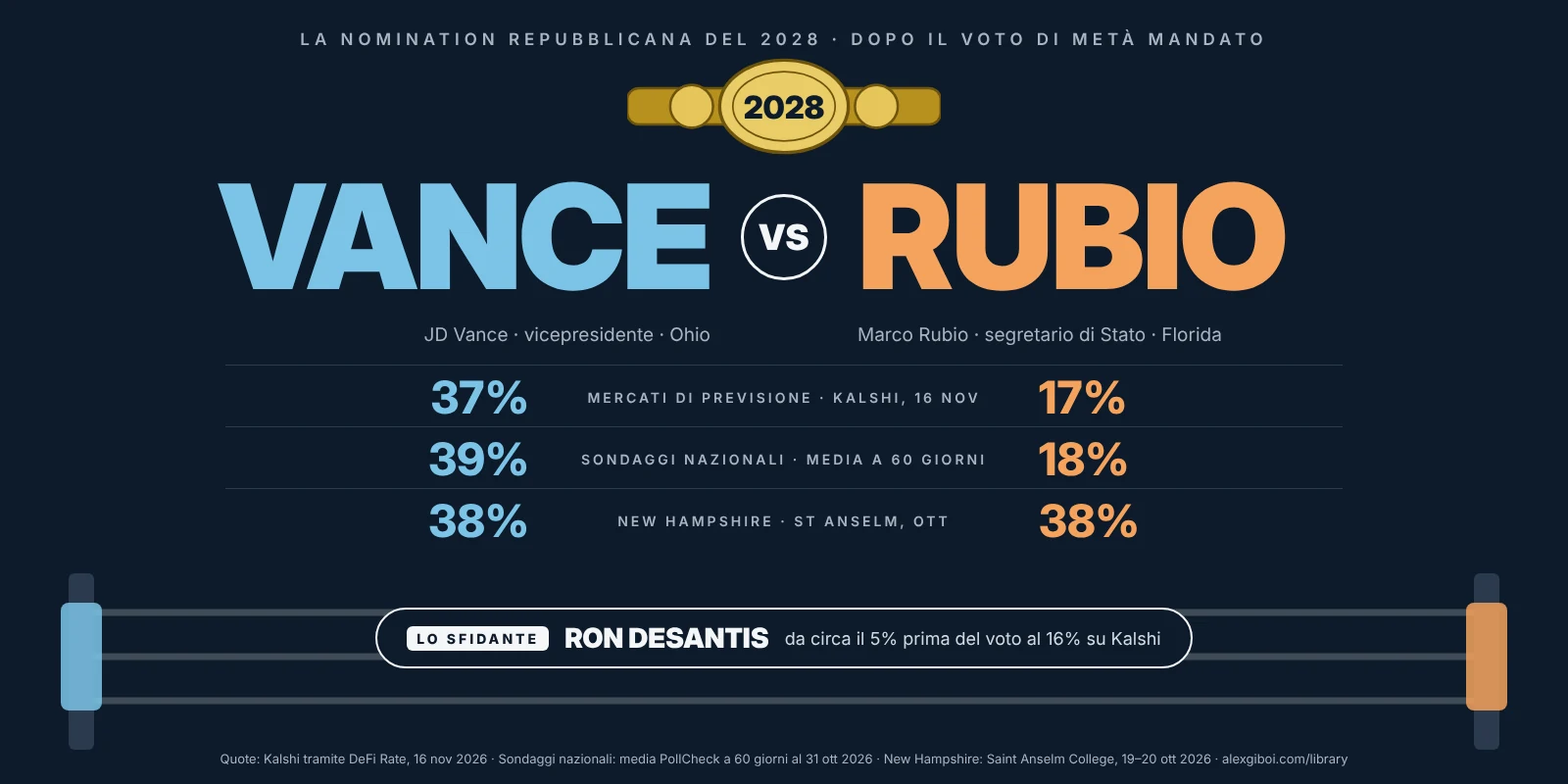
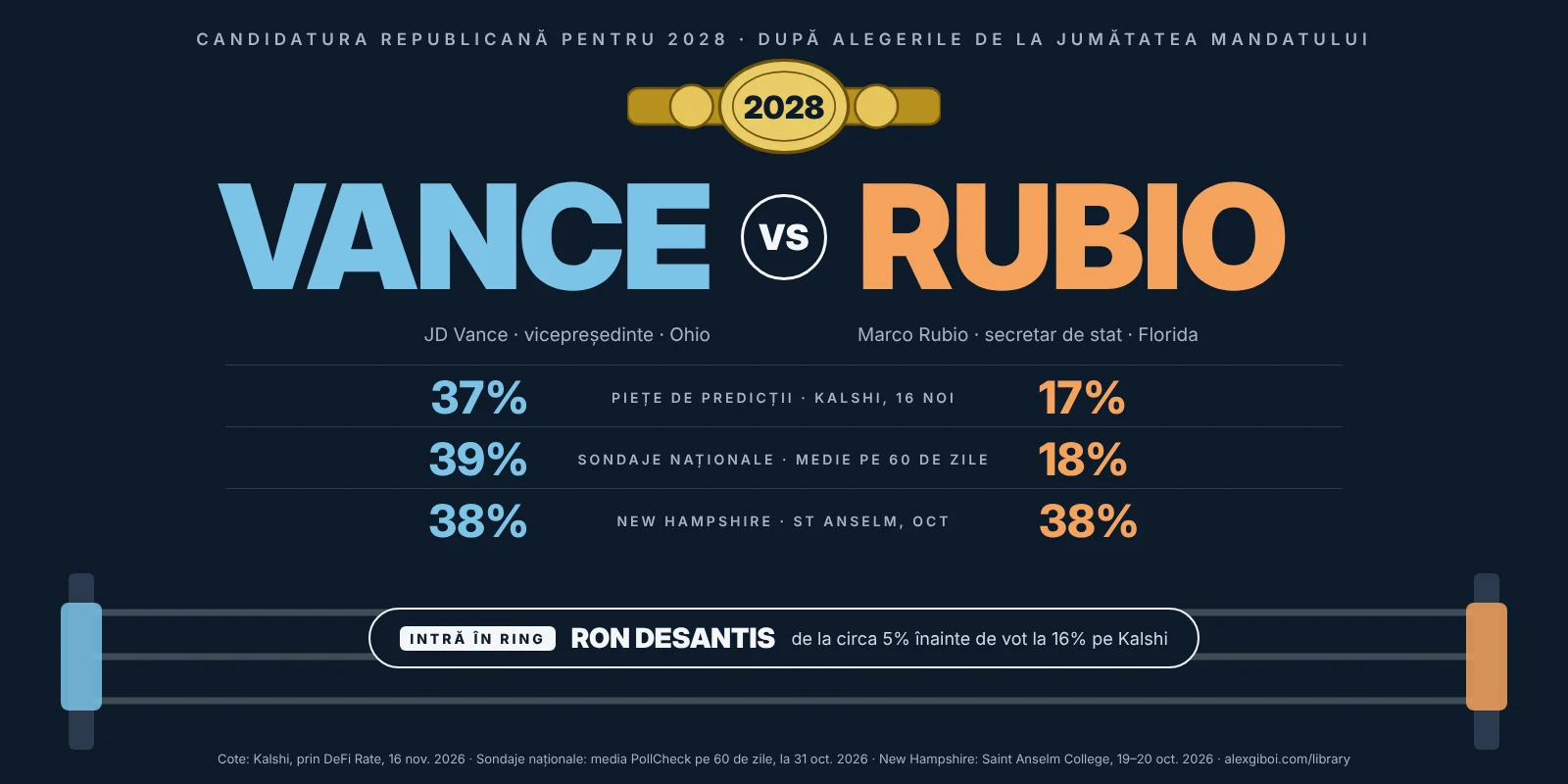
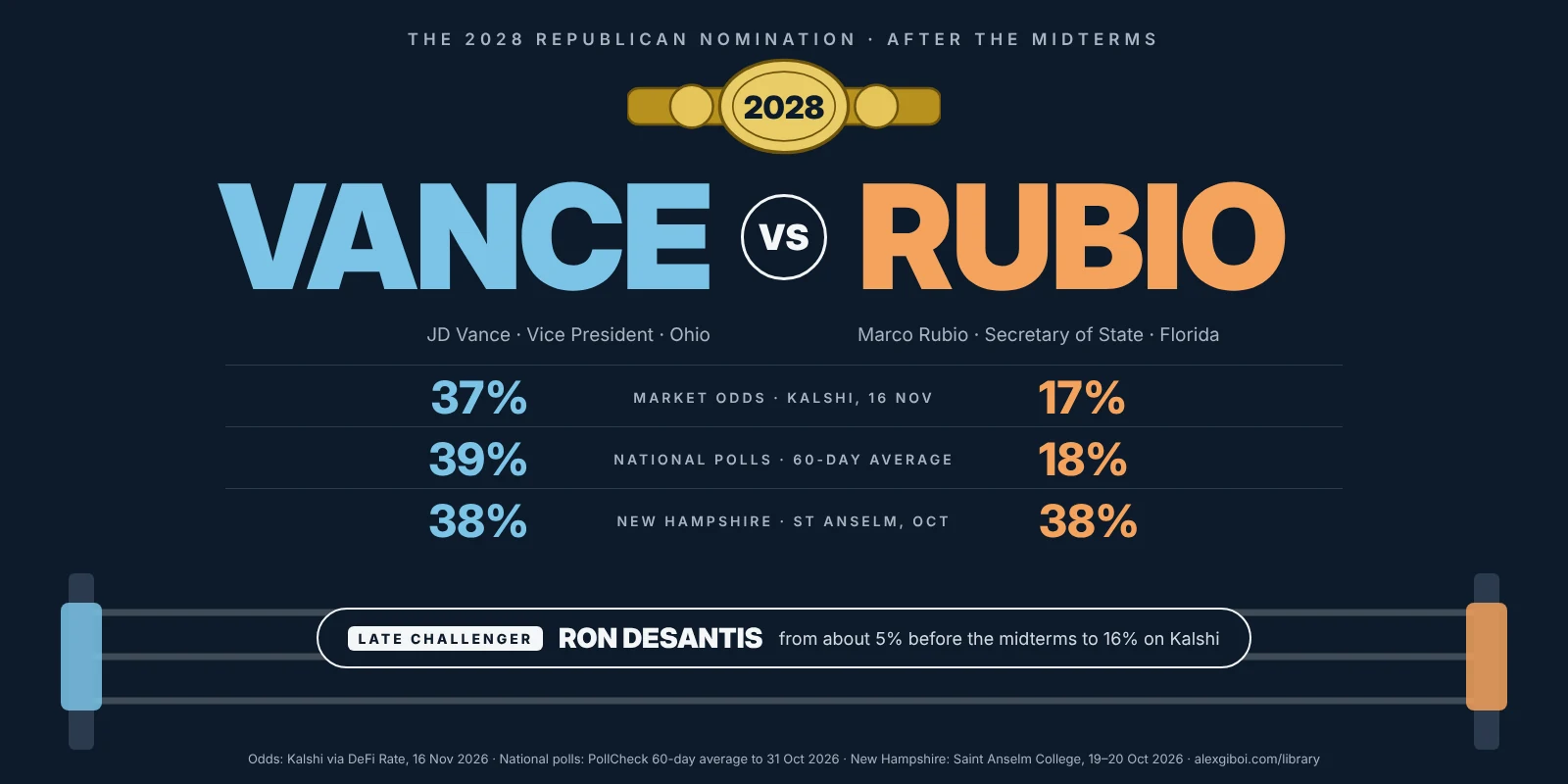
The big move came within 24 hours of the results. On election day, DeSantis was still trading around 5%; by the next evening he was near 20%, while Vance slipped from 35% to 31%. A month earlier, on 4 October, Kalshi had Vance at 45% and Rubio at 18%. In the days that followed, prices settled somewhat: by 9 November Vance was back at 34%, Rubio at 21% and DeSantis at 17%. A week later, on 16 November, Vance stood at 37%, Rubio at 17% and DeSantis at 16%, still about three times his pre-election price. Polymarket shows a similar picture, with Vance at 37%, Rubio at 16% and DeSantis at 15% (DeFi Rate, 16 November). No other name traded above 5% on either market; the next, former Trump aide John McEntee, was at about 4%.
What traders rewarded in DeSantis was distance. He called the outcome a worst-case scenario for Republicans and, in a SiriusXM interview, argued that the confrontation with Iran was pushing up fuel prices and hurting working-class voters. He also called for a ban on stock trading by members of Congress. After a defeat, a Republican willing to criticise the administration looks like an asset to the market.
What the voters say
Polls tell a slightly different story. Before the midterms, Vance led clearly nationally: the PollCheck average of 11 national polls through 31 October has him at 39%, ahead of Rubio (18%), Donald Trump Jr. (13%) and DeSantis (9%). The PollCheck average could not be rechecked for this update, so these are still the figures from 31 October. RealClearPolling’s average, which includes polls up to 1 November, has Vance at 38%, Rubio at 26% and DeSantis at 8%. The last national poll before the vote, by AtlasIntel (31 October–1 November), put Rubio ahead, 46% to 33%; the other national polls in RealClearPolling’s list since late August show Vance ahead by 12 to 22 points (RealClearPolling, checked 10 November).
The first polls taken after the vote point in different directions. In an Economist/YouGov poll of 9–11 November, which asked intended Republican primary voters an open question about whom they would vote for, 40% named Vance, 33% Rubio, 14% DeSantis and 9% Donald Trump. A Cygnal survey of 3,000 midterm voters on 4–5 November, reported by USA Today, found Rubio ahead of Vance by more than three points, with DeSantis a distant third; the published report gives no exact Republican figures.
New Hampshire, traditionally the first state to hold a Republican primary, is where Rubio’s rise shows most.
One national poll pointed the same way: Emerson College found the two essentially tied in May. A first post-midterm poll in New Hampshire will show whether the state’s Republicans have moved since October.
What will decide it
- Trump’s blessing. Trump has praised both Vance and Rubio and called a joint Vance–Rubio ticket “unstoppable”, without saying who should lead it. Fox News has also reported, citing a source, that he told donors the party needed to elect Vance. A formal endorsement was widely expected only after the midterms. Asked about it on CBS’s 60 Minutes, aired on 8 November, Trump said “Probably, not necessarily”, spoke of a “tremendous bench” and said “I may or may not get involved”, according to Newsweek.
- Whether Vance runs, and whether Rubio steps aside. Vance has said he would discuss 2028 with his family and with Trump after the midterms. According to The Wall Street Journal, as reported by NJ.com on 9 November, he has told associates he has not decided, and some people close to him doubt that a Republican can win in 2028. Axios reported on 15 November that he will not make a final decision until after the new year. Fox News reported that his post-election comment linking the party’s losses to the war with Iran drew criticism from some Republicans. Rubio has said he would back Vance if the vice president runs. While that pledge holds, the rivalry is a question of who goes first, not a head-to-head primary.
- Closeness to Trump: asset or liability? Before the vote, analysts already warned that heavy losses could make primary voters look for someone with more distance from the president. That is exactly the lane DeSantis has started to claim.
- Money and machinery. As finance chair of the Republican National Committee, Vance sits at the centre of the party’s donor network, an advantage no rival can match quickly.
Bottom line
Vance remains the man to beat. But a year ago, markets treated him as close to a one-in-two bet. Today they price him at a little over one in three, slightly more than Rubio and DeSantis combined on Kalshi. The Republican race to succeed Trump has gone from a coronation to a contest, and the next few months of decisions, by Vance, by Rubio and above all by Trump, will settle its shape.
Sources
- Prediction-market prices, 4 October, 4, 9 and 16 November 2026. DeFi Rate (Kalshi and Polymarket, observed 16 November, 7:39 pm ET; previous reading 9 November, 1:14 pm ET); KalshiView (Kalshi snapshot, 16 November); Newsweek (Kalshi and Polymarket, 13 November; College Republican straw polls); Newsweek (Kalshi and Polymarket, 8 November); DeFi Rate (Kalshi and Polymarket, 4 October); Tampa Free Press (Kalshi, 3–4 November; DeSantis interview on SiriusXM); Kalshi midterms recap.
- Trump on his successor (CBS, 60 Minutes, aired 8 November 2026). Newsweek.
- Vance undecided on 2028. NJ.com, 9 November 2026, citing The Wall Street Journal; Mediaite via Yahoo News, 16 November 2026, citing Axios (decision after the new year); Fox News, 14 November 2026 (reaction to Vance’s post-election remarks).
- New national polls after the midterms. YouGov (Economist/YouGov poll, 9–11 November 2026, published 13 November); USA Today (Cygnal poll, 4–5 November 2026, published 16 November).
- DeSantis on the midterm result. Newsweek.
- Polls. PollCheck, national Republican primary average (11 polls, 60 days to 31 October 2026; could not be rechecked on 17 November); PollCheck, New Hampshire polls (University of New Hampshire; Saint Anselm College); abc27 (Emerson College poll, May 2026); RealClearPolling, national polls and average (checked 10 November 2026); RealClearPolling, New Hampshire polls (checked 10 November 2026).
- Trump, Vance and Rubio on 2028. Fox News (Vance–Rubio ticket; Rubio backing Vance); Fox News (Trump’s remark to donors; Vance’s plans after the midterms); Jerusalem Post (Reuters); CBS 42 (endorsement expected after the midterms); ARY News (AFP); Gulf News (AFP, RNC finance role).
- Closeness to Trump as a liability. The Center Square, via Just the News.
Researched and written with the help of Claude (Anthropic), based on the public sources listed above, and checked by me. Figures as of 16 November 2026; last updated 17 November 2026. Corrections welcome.